


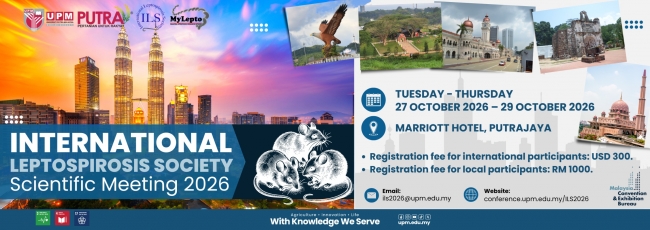
Tentative Programme
The programme below outlines the tentative schedule of sessions and activities planned for the conference.
International Leptospirosis Society Scientific Meeting (ILS 2026) Program
Date: 27–29 October 2026
Venue: Putrajaya Marriott Hotel, Putrajaya, Malaysia
Day 1 — Tuesday, 27 October 2026
Theme 1: Integrated Leptospirosis Control
|
Time |
Programme |
|
8:00–9:00 AM |
Registration |
|
9:00–9:25 AM |
Opening Ceremony |
|
9:25–9:45 AM |
Plenary Address — Leptospirosis in a Changing World: Strengthening Public Health Surveillance and One Health Response Dr Mohd Hanif Zailani, Head of Zoonosis Control Sector, Infection Control Division, Ministry of Health Malaysia |
|
9:45–10:45 AM |
Coffee Break and Poster Viewing/Evaluation |
|
10:45 AM–1:00 PM |
Oral Presentation Session I One Health, Epidemiology and Ecology of Leptospirosis |
|
10:45–11:00 AM |
A Pathway to the Future – Bringing a Neglected Disease to the Spotlight One Experiment at a Time Elsio A. Wunder Jr. Department of Pathobiology and Veterinary Science, College of Agriculture, Health and Natural Resources, University of Connecticut, United States of America. |
|
11:00–11:15 AM |
Diversity, ecology, epidemiology, and Leptospira reservoirs Carcauzon Victoria (France) |
|
11:15–11:30 AM |
A Multi-Landscape Assessment of Leptospira Prevalence on a Diversity of Small Mammals Dr. Farah Shafawati Mohd-Taib (Malaysia) |
|
11:30–12:00 PM |
Keynote Address — Bridging Boundaries: An Integrated One Health Approach to the Control and Management of Leptospirosis in an Endemic State in India Dr. V. Balamurugan, India Principal Scientist-Veterinary Microbiology, WOAH Designated Expert / Head WOAH Reference Laboratory for PPR & Leptospirosis, ICAR-NIVEDI, Karnataka India |
|
12:00–12:15 PM |
Leptospira prevalence, cycling, and infection in rural Ecuador Talima Pearson (USA) |
|
12:15–12:30 PM |
A currently unculturable lineage of Leptospira borgpetersenii has infected cattle in multiple U.S. states and is genetically linked to samples from cattle in New Zealand and Uganda Dave Wagner (USA) |
|
12:30–12:45 PM |
Urinary Shedding of Pathogenic Leptospira spp. Across Hosts: A Systematic Review of Reservoirs and Transmission Risk. Gustavo Monti (Netherlands) |
|
12:45–1:00 PM |
Novel Strain of Leptospira interrogans Identified in the Environment Caused Severe Leptospirosis in Berry Farm Workers in California 2024 Nathan E. Stone (USA) |
|
1:00–2:00 PM |
Lunch and Networking |
|
2:00–2:30 PM |
Flash Presentation Session I |
|
2:00–2:05 PM |
A Jigsaw Approach to Building One Health Evidence for Leptospirosis in Uganda Lordrick Alinaitwe (Uganda) |
|
2:05–2:10 PM |
Detection of Leptospira in the Reproductive Tracts and Urine of Female Cull Cattle in Southeastern United States Myranda Gorman (USA) |
|
2:10–2:15 PM |
Laboratory-confirmed leptospirosis and associated risk factors among undifferentiated febrile illness patients in Jaffna district, Sri Lanka: A hospital-based study Yanuthy Tharsan (Sri Lanka) |
|
2:15–2:20 PM |
Current Status and Future Challenges of Leptospirosis Hotspots in the Philippines: Recommendation for Policy Development Christopher Allan F. Reballos (Philippines) |
|
2:20–2:30 PM |
Q&A |
|
2:30–5:30 PM |
Oral Presentation Session II Transmission, Surveillance and Community Action |
|
2:30–2:45 PM |
LAWA PH: Strengthening One Health Strategies for Community Leptospirosis Prevention Khristine Sandoval (Philippines) National University, Philippines, Manila, Philippines |
|
2:45–3:00 PM |
Quantifying under-reporting of leptospirosis in the Taranaki region, New Zealand Julie Collins-Emerson (New Zealand) |
|
3:00–3:15 PM |
A One Health risk stratification model for leptospirosis surveillance using multiple correspondence analysis and hierarchical clustering in Côte d’Ivoire. Koffi Kouadio Stéphane (Côte d'Ivoire) |
|
3:15–3:30 PM |
Accounting for Spatial Heterogeneity in Environmental Covariates in Regression Analyses of Leptospirosis Surveillance Data Brent Strong (USA) |
|
3:30–3:45 PM |
Twenty-Five Years of Leptospira Surveillance in Costa Rica: Integrating Serology, Genomics, and a Global Perspective on Leptospira santarosai Diana Chinchilla (Costa Rica) |
|
3:45–4:15 PM |
Coffee Break and Poster Viewing/Evaluation |
|
4:15–4:30 PM |
From an Uncommon Finding to an Emerging Public Health Concern: Two Decades of Leptospira spp. Serogroup Pomona in Croatia Iva Benvin (Croatia) |
|
4:30–4:45 PM |
Molecular epidemiology of the 2025 leptospirosis surge at San Lazaro Hospital, Manila, the Philippines, by direct multilocus sequence typing. Ryan McCorkell (Japan) |
|
4:45–5:00 PM |
Spatial Epidemiological Approaches to Inform One Health Interventions during Leptospirosis Outbreak in Pangandaran, Indonesia Pandji Wibawa Dhewantara (Indonesia) |
|
5:00–5:15 PM |
Leptospirosis Outbreak Among Crew Members of a Fishing Vessel in Indonesia: Epidemiology, Clinical, Laboratory Findings, Public Health Response Farida Dwi Handayani (Indonesia) |
|
5:15–5:30 PM |
Knowledge, Attitudes, and Practices of Rice Farmers on Leptospirosis in a Rural Municipality in the Philippines Melchor G. Eda Jr. (Philippines) |
|
5:30 PM |
End of Day 1 |
|
5:45–7:00 PM |
International MAT Proficiency Testing Discussion (private) |
Day 2 — Wednesday, 28 October 2026 Morning Programme
Theme: Integrated Leptospirosis Control — Continued
|
Time |
Programme |
|
8:00–9:00 AM |
ILS Business meeting (Private) |
|
8:00–9:00 AM |
Poster Viewing/Evaluation |
|
9:00–10:30 AM |
Oral Presentation Session III |
9:00-9.15 AM
|
A One Health Framework to Understand and Mitigate Climate-driven Leptospirosis in Aotearoa New Zealand
Jackie Benschop (New Zealand) Massey University, |
|
9:15–9:30 AM |
Rising in Rural Pahang: Five-year Epidemiological Trends of Leptospirosis in Malaysia, 2021-2025 Dr Widad Ulya Binti Mohamed Yusof (Malaysia) |
|
9:30–9:45 AM |
Spatial clustering and ecological correlates of human leptospirosis in Jaffna, Sri Lanka, from 2019 to 2024 Yanuthy Tharsan (Sri Lanka) |
|
9:45–10:00 AM |
Spatial clustering and environmental correlates of leptospirosis seroprevalence in pregnant women from Anuradhapura, Sri Lanka: An ecological study Shashanka Rajapakse (Sri Lanka) |
|
10:00–10:15 AM |
Population-Based Seroincidence and of Leptospiral Infection During Pregnancy in Rural Sri Lanka: The Rajarata Pregnancy Cohort Madushika Sewwandi (Sri Lanka) |
|
10:15–10:30 AM |
Leptospirosis Occurs as Frequently as Malaria Among Acute Febrile Adolescent and Adult Patients in Hoima, Uganda Andrew Vivian Kirabo (Uganda) |
|
10:30–11:00 AM |
Coffee Break and Poster Viewing/Evaluation |
|
11:00–1:00 PM |
Oral Presentation Session IV Environmental Risk, Transmission Dynamics and Community Prevention |
|
11.00-11.15AM |
Gamifying Leptospirosis Prevention: From Awareness to Action Syafinaz Amin Nordin (Malaysia) Professor, Medical Microbiology, Faculty of Medicine and Health Sciences, UPM, Malaysia |
|
11:15–11:30 AM |
Hydrological and Epidemiological Modeling of Leptospirosis in a Tropical Environment Juan Manuel Cordovez (Colombia) |
|
11:30–11:45 AM |
Study of the environmental impact of leptospirosis in Algeria (2010-2024) Anissa Amara Korba (Algeria) |
|
11:45–12:00 PM |
Environmental Distribution of Pathogenic Leptospira spp. in Subtropical Rivers of Japan Atsuhiro Kanayama (Japan) |
|
12:00–12:15 PM |
Spatially Uniform and Matrix-Independent Distribution of Diverse Leptospira spp. In Estero de Paco, Manila, Philippines Ram Julius L. Marababol (Philippines) |
|
12:15–12:30 PM |
Detection of pathogenic Leptospira, including a new species, across environmental samples in urban and rural settings in the Netherlands Priscyla dos Santos Ribeiro (Netherlands) |
|
12:30–12:45 PM |
Leptospirosis during the 2025 monsoon flood in Sawai Madhopur district, Rajasthan, India: human, environmental and meteorological findings Ankoor Tyagi (India) |
|
12:45–1:00 PM |
Exposure to Leptospira in Munich's Urban River Surfers Martin H. Richter (Germany) |
|
1:00–2:00 PM |
Lunch and Networking |
Afternoon
Theme 2: Understanding Disease: Pathogenesis, Clinical Insights and Innovations
|
Time |
Programme |
|
2:00–2:30 PM |
Keynote Address — Human Clinical Leptospirosis Wimalasiri Uluwattage National Hospital, Galle, Sri Lanka |
|
2:30–5:00 PM |
Oral Presentation Session I Clinical Disease, Outcomes and Long-Term Impact |
|
2:30–2:45 PM |
Clinical Leptospirosis: A Malaysian Perspective Assoc Prof Dr Yazli Yuhana Infectious Diseases Service KPJ Healthcare University and Ampang Puteri Specialist Hospital, Malaysia |
|
2:45–3:00 PM |
Clinical Predictors of Fatal Outcomes in Human Leptospirosis, Thailand, 2015-2024 Umaporn Limothai (Thailand) |
|
3:00–3:15 PM |
Qualitative analysis reveals clinical complexities in diagnosing and managing leptospirosis in New Zealand Dr Tanya Maria Quin (New Zealand) |
|
3:15–3:30 PM |
Gene sequence diversity of key pathogen-associated molecular patterns among clinical isolates of Leptospira in Sri Lanka Chamila Kappagoda (Sri Lanka) |
|
3:30–3:45 PM |
Persistence of serological response following leptospirosis - A longitudinal study Dilrukshi Menike (Sri Lanka) |
|
3:45–4:00 PM |
Waning of Naturally Acquired Anti-Leptospira Antibodies During Pregnancy: A Longitudinal Cohort Analysis Janith Warnasekara (Sri Lanka) |
|
4:00–4:30 PM |
Coffee Break and Poster Viewing/Evaluation |
|
4:30–4:45 PM |
Chronic sequelae following leptospirosis in Aotearoa New Zealand: a nationwide cohort study Shahista Nisa (New Zealand) |
|
4:45–5:00 PM |
Direct and Indirect Costs Incurred by Clinically Diagnosed Leptospirosis Patients Admitted to the Teaching Hospital, Anuradhapura, Sri Lanka Manojika Jayasinghe (Sri Lanka) |
|
5:00–5:50 PM |
Flash Presentation Session II |
|
5:00–5:05 PM |
Leptospirosis: A Leading Identified Cause of Acute Undifferentiated Fever Presenting as Community-acquired Sepsis at Udon Thani Hospital, Thailand Atiwit Loucharoen (Thailand) |
|
5:05–5:10 PM |
Validating a simple score to predict severe leptospirosis Patrick Rosengren (Australia) |
|
5:10–5:15 PM |
Characterization of Epithelial and Endothelial Junctional Proteins in Human Leptospirosis and Experimental Models of Leptospira Infection Milena Carvalho Carneiro (Brazil) |
|
5:15–5:20 PM |
Participation of the Complement System in Experimental Leptospirosis-Associated Pulmonary Hemorrhagic Syndrome Lara Rodrigues da Silva (Brazil) |
|
5:20–5:25 PM |
Whole-Genome Sequencing and Pathogenicity Characterization Reveal the Virulence of Leptospira interrogans Isolated from a Greater Bandicoot Rat (Bandicota indica) in a Leptospirosis Hotspot of Southern India Prajakta Prashant Bokade (India) |
|
5:25–5:30 PM |
Phylogenetic and functional evolution of copper homeostasis systems in Leptospira: evidence for a regulator switch between CueR and CsoR Gregoire Davignon (New Caledonia) |
|
5:30–5:35 PM |
Transcriptional Regulatory Model of Biofilm-Associated Regulons in Leptospira biflexa Larissa Vasconcelos (Brazil) |
|
5:35–5:50 PM |
Q&A |
Day 3 — Thursday, 29 October 2026 Morning Programme
Understanding Disease: Pathogenesis, Clinical Insights & Innovations — Continued
|
Time |
Programme |
|
8:30–10:30 AM |
Oral Presentation Session II Pathogenesis, Host Adaptation and Immune Responses |
|
8:30–8:45 AM |
Deciphering Host Adaptation and Virulence Mechanisms in Leptospira interrogans Mathieu Picardeau (France) |
|
8:45–9:00 AM |
Role of NLRP3 activation in host-specific immune responses against Leptospira interrogans David A. Haake (USA) |
|
9:00–9:15 AM |
Expansion of WC1⁺CD8⁺ γδ T cells, upregulation of immune effector and activation genes, together with reduced CD14⁺ monocyte responses, characterize immunity in cattle experimentally challenged with Leptospira kirschneri serovar Grippotyphosa Marcella Mori (Belgium) |
|
9:15–9:30 AM |
Signaling and regulatory network for host adaptation in Leptospira Nadia BENAROUDJ (France) |
|
9:30–9:45 AM |
Distinct Molecular Trajectories Underlie a Shared Lethal Outcome in Experimental Acute Leptospirosis Sreekumari Rajeev (USA) |
|
9:45–10:00 AM |
Deciphering the C-degron tag encoded by a small stable RNA A (SsrA) in facilitating protein degradation by the Leptospira interrogans caseinolytic protease machinery ClpAP1P2 Kumar Manish (India) |
|
10:00–10:15 AM |
Systems Biology Reveals the Central Role of Glucose in Leptospira Adaptation to Host Temperature Ryo Ozuru (Japan) |
|
10:15–10:30 AM |
Proteasome-dependent aberrant collective cell migration in Leptospira-infected renal epithelial cells Claudia Toma (Japan) |
|
10:30–11:00 AM |
Coffee Break and Poster Viewing/Evaluation |
|
11:00 –12:00 PM |
ILS Meeting |
Theme 3: Current and Next-Generation Tools for Leptospirosis: Diagnostics, Therapies and Vaccines
|
Time |
Programme |
|
12:00–12:30 PM |
Keynote Address — Immune cell responses to Leptospira infection in the murine host Maria Gomes-Solecki Professor, Microbiology, Immunology and Biochemistry, UTHSC, USA |
|
12:30–1:00 PM |
Oral Presentation Session I |
|
12:30–12:45 PM |
Leptospirosis diagnostic capacity in Malaysia: From History to Integrative Genomic and Serological Tools Murnihayati Hassan (Malaysia) Bacteriology Unit, Infectious Disease Research Centre, Institute for Medical Research, National Institutes of Health, Ministry of Health Malaysia |
|
12:45–1:00 PM |
When the Reference Standard Is Imperfect: A Comparative Evaluation of IgM ELISA and MAT for Leptospirosis Diagnosis Shikha Tiwari (India) |
|
1:00–2:00 PM |
Lunch and Networking |
|
2:00–2:50 PM |
Flash Presentation Session III |
|
2:00–2:05 PM |
Development and validation of a multiplex real-time PCR assay for simultaneous detection and speciation of pathogenic Leptospira in New Zealand Stuart Littlejohn (New Zealand) |
|
2:05–2:10 PM |
Expanding the Diagnostic Toolbox for High-Throughput Bovine Leptospirosis Diagnosis: Belgian Case-Control Validation of Competitive ELISAs for Grippotyphosa and Australis Serovars Michaël Van Nimmen (Belgium) |
|
2:10–2:15 PM |
Development of a Gold Nanoparticle-Based Electrochemical Aptasensor for Rapid Detection of Pathogenic Leptospira in Canine Urine. Nouraldin K.N Houbri (Thailand) |
|
2:15–2:20 PM |
Dissecting cell surface protein diversity to enhance leptospiral vaccine efficacy Abbie Hinds (United Kingdom) |
|
2:20–2:25 PM |
Integrative In silico and In vitro approaches toward a Multi-Epitope Subunit Vaccine against Leptospirosis Jemima John, Bhairavi Balasubramanian (India) |
|
2:25–2:30 PM |
Efficacy and safety treatment outcomes of importance to patients and healthcare providers for a future leptospirosis trial: A qualitative study Nathaniel Lee (Japan) |
|
2:30–2:35 PM |
A Next-Generation Multi-Epitope Vaccine Against Leptospirosis: From Molecular Characterization to Immune Activation Bothammal Palanisamy (India) |
|
2:35–2:50 PM |
Q&A |
|
2:50–4:35 PM |
Oral Presentation Session I continued |
|
2:50–3:05 PM |
Evaluation of five Leptospira real-time PCR assays widely used for diagnostics Ahmed Ahmed Ahmed (Netherlands) |
|
3:05–3:20 PM |
Development of Diagnostic Peptides leveraging Multi-Stage Subtractive Proteomics-driven Target Selection for early detection of Leptospirosis Sambandam Ravikumar (India) |
|
3:20–3:35 PM |
Aptamer Based Molecular Diagnostic methods for Leptospirosis M. Ramya (India) |
|
3:35–3:50 PM |
Deciphering Leptospira-Host Interactions through Integrated Multi-omics: From Virulence Factor Discovery to Vaccine Design Syed M. Faisal (India) |
|
3:50–4:05 PM |
Development of a core outcome and measurement set for international leptospirosis trials (COS-LEP) Nathaniel Lee (Japan) |
|
4:05–4:20 PM |
β-lactam antibiotics trigger TLR-dependent Jarisch-Herxheimer reaction in leptospirosis Catherine Werts (France) |
|
4:20–4:35 PM |
Role of N-Acetylcysteine in Targeting Tubular Injury and Oxidative Stress in Leptospirosis: A Randomized Placebo-Controlled Trial Selfie, SPPD, FINASIM, MARS (Indonesia) |
|
4:35–5:15 PM |
Day 3 Wrap-Up, Closing Remarks and Awards |
|
5:15 PM |
Coffee and Departure |
Programme at a Glance
Theme 1: Integrated Leptospirosis Control
Session I – One Health, Epidemiology and Ecology of Leptospirosis Session II – Transmission, Surveillance and Community Action
Session III – Human Epidemiology, Clinical Disease and Population Risk
Session IV – Environmental Risk, Transmission Dynamics and Community Prevention
Theme 2: Understanding Disease – Pathogenesis, Clinical Insights and Innovations
Session I — Clinical Disease, Outcomes and Long-Term Impact
Session II — Pathogenesis, Host Adaptation and Immune Responses
Theme 3: Current and Next-Generation Tools for Leptospirosis: Diagnostics, Therapies and Vaccines
Note: The program is subject to change due to the finalization of speakers’ attendance. Participants will be duly informed of any changes.